
Handshake: Jobs & AI work
Handshake (Stryder Corp.)Business
4.51.29K Reviews
- Version
- 5.22.0
- Installs
- 1.00M
- Age Rating
- Everyone
Screenshots
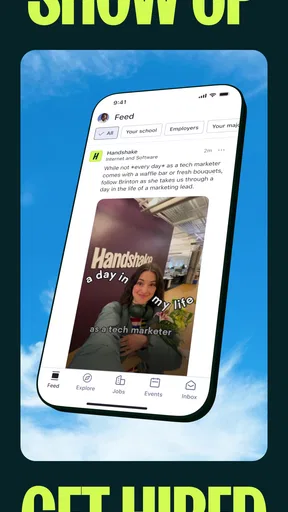
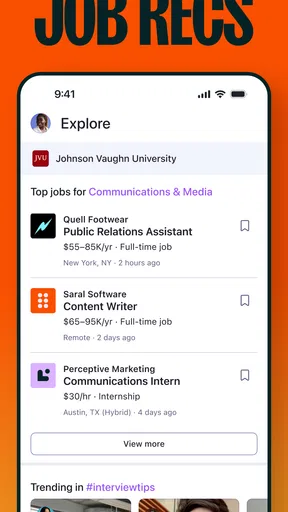
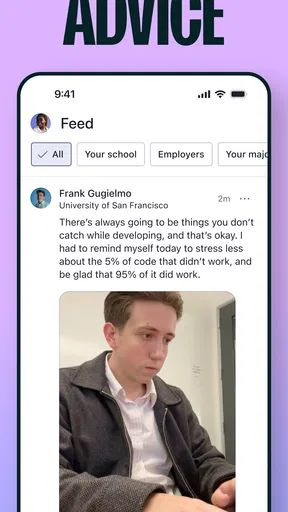
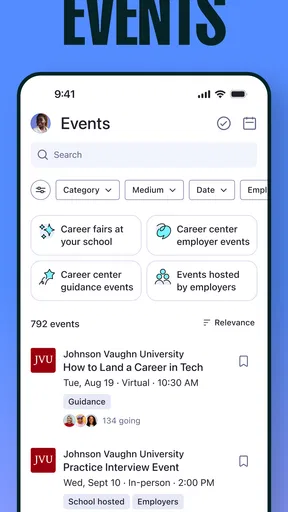

Our Review of Handshake: Jobs & AI work
 Analysis by Appyee
When I look for a job app, I want more than a long list of vacancies. I want to know whether it helps me discover realistic opportunities, understand what kind of work suits me, and move from browsing to applying without turning the process into a second full-time job. That is the standard I used with Handshake Jobs & New Careers, a free business app from Handshake (Stryder Corp.) built around jobs, internships, and career inspiration.
My overall impression is that it makes the most sense for students, recent graduates, and people still shaping their first professional direction. It is less convincing as a complete replacement for every job-search method, especially if you already know the exact role, company, or industry you want. In that situation, a specialist board, a company careers page, or a professional networking service may get you to a suitable vacancy faster.
The app has a 4.5 average from around 9.5 thousand ratings, with more than a thousand written reviews and over a million installs. Those figures suggest that it has reached a substantial audience, but they do not remove the need to judge whether its approach matches your own search. I found that its real value depends less on how many listings appear and more on how deliberately you use the discovery tools around them.
How I would decide whether Handshake is right for me
I’d decide by giving Handshake one clear job in my search: helping me explore possibilities I haven’t yet learned how to name. I’d then judge whether it brings useful options or sharper questions, rather than counting how long I spend browsing. That distinction helps me choose the right role for it in my routine before I commit more attention to another app.
The best starting point is your level of certainty
The first question is not whether Handshake has enough jobs. It is whether I am still exploring or already pursuing a defined target. If I am comparing internships, entry-level roles, campus-related opportunities, or possible career paths, the app feels naturally suited to that stage. It gives the search a broader frame than simply typing a job title into a general vacancy website.
That distinction matters because early-career searches are often unclear. I may be interested in marketing but unsure whether I prefer content, research, sales, or communications. I may want an internship but not know which employers regularly consider candidates without much experience. In these cases, browsing is not wasted time; it is part of learning what the market calls different roles. Handshake is strongest when I treat it as a career-discovery tool rather than a vending machine for applications.
On the other hand, someone searching for a very specific senior position may find the experience less efficient. A person who already has a polished résumé, a narrow location requirement, and a fixed salary expectation usually benefits from filters and networks designed around precise recruitment. Handshake can still be useful, but it may not be the first place I would spend limited search time.
What I would prepare before installing it
I get more from the app when I decide in advance what I am willing to consider. I would write down a few acceptable role families rather than one perfect title, then separate non-negotiables from preferences. For example, location, work schedule, study compatibility, and required experience may be firm limits, while industry or company size may remain flexible.
This small preparation prevents a common problem with job apps: saving attractive-looking vacancies that do not actually fit. It also makes the app’s inspirational side more useful. Instead of scrolling passively, I can ask why a listing caught my attention and whether it points toward a genuine option or merely sounds appealing.
I would also keep a simple note outside the app with the date I viewed a vacancy, the closing information shown, and the next step I need to take. This is a practical habit because job discovery and application tracking are not always the same activity. A discovery-focused app can help me find possibilities, but I still need my own system for follow-up.
Where it fits in a normal job-search routine
I would use Handshake in short, focused sessions rather than leaving it open for endless scrolling. A useful routine would be to browse for discovery, save only roles that pass my basic checks, and then spend a separate session tailoring an application. That separation helps me avoid applying impulsively just because a listing appeared at the right moment.
For a student, the app could sit alongside coursework and occasional career research. For a recent graduate, it could support a wider search while a résumé and portfolio are being refined. For someone changing direction, it can provide vocabulary for new roles and help reveal which entry-level pathways are realistic. In each case, the app is most valuable when it informs a decision rather than making the decision for me.
Where the experience feels most useful
The strongest part of the product is the combination of practical vacancies with career inspiration. Many general job boards assume I already know what I want. Handshake is more comfortable with the uncertain middle stage, where I am collecting ideas, comparing possibilities, and trying to understand how internships connect with longer-term work.
I particularly appreciate that this approach can change the quality of my search terms. After seeing how employers describe roles, I may discover that the position I imagined has a different title or sits in another department. That is a non-obvious benefit: the app can improve my search vocabulary before it improves my application count.
It is also a useful place to look when I want opportunities connected to the beginning of a career rather than only established professional experience. I would not assume every listing is suitable for every student, but the overall orientation makes the app more approachable than a platform dominated by seniority, networking visibility, or highly polished professional profiles.
A realistic everyday scenario
Imagine I am finishing a course and have two possible directions: communications and customer success. I have no interest in submitting twenty generic applications, but I also do not want to choose a path based only on the course title I studied. I could use Handshake to browse internships and early-career roles in both areas, compare the language employers use, and note which skills appear repeatedly.
After that first exploration, I would narrow the search to a few roles that match my schedule and experience. I would read each description carefully, identify the evidence I can provide, and adapt my résumé or cover letter accordingly. The app would not replace the work of presenting myself well, but it could help me make that work more targeted.
The important trade-off is that this process may feel slower than searching one exact phrase. In return, I may avoid overlooking a suitable role simply because I used the wrong title. For an undecided applicant, that is a worthwhile exchange. For an experienced specialist who already knows the precise vacancy they want, it may feel like unnecessary wandering.
Small workflow improvements that make a difference
My first recommendation is to judge a listing twice: once for interest and once for fit. During the first pass, I ask whether the role sparks curiosity. During the second, I check experience, location, schedule, application requirements, and whether I can explain why I am a plausible candidate. This two-pass method keeps inspiration from turning into a pile of unrealistic saved jobs.
My second tip is to use rejected listings as research. If a role looks attractive but asks for skills I do not have, I would record those skills and look for beginner-friendly ways to build evidence. That turns browsing into a learning plan instead of a repeated reminder that I am not qualified yet.
My third tip is to compare similar roles across employers rather than reading each vacancy in isolation. Differences in responsibilities can reveal whether a title is being used broadly or narrowly. This is especially helpful for people entering fields where job names overlap and the day-to-day work is not obvious from the headline.
What the app does not solve for me
No job-search app can guarantee that a promising listing becomes an interview. I still need a clear résumé, accurate application details, and patience with employer timelines. Handshake’s discovery angle may help me find a direction, but it cannot judge the quality of my application or replace preparation for an interview.
I also would not rely on any listing without reading its full requirements and checking the employer context available to me. A polished description can still represent a poor personal fit. The app can shorten the path to an opportunity, but I remain responsible for deciding whether that opportunity deserves my time.
Another limitation is psychological rather than technical: inspiration can become distraction. Career content and broad browsing are useful when I am exploring, but they can pull me away from applications that actually matter. I would set a specific purpose for each session so that discovery supports action instead of becoming an easy way to postpone it.
How it compares with familiar alternatives
Compared with a general job board, Handshake feels more oriented toward early-career exploration and internships. A broad board may be better when I want maximum coverage across industries and experience levels, especially for a highly specific vacancy. Handshake is more appealing when I need help understanding what to search for in the first place.
Compared with a professional networking platform, it places less emphasis on building a public professional identity as the main route to opportunity. Networking can be powerful when I have contacts, a strong profile, or a clear list of people to approach. Handshake is easier to approach as a direct search and discovery experience, although it should not make me ignore the value of personal referrals and conversations.
Compared with visiting company career pages individually, it saves me from starting every search from zero. Company sites remain valuable when I have a shortlist of employers or want the most direct application route. Handshake is better for widening the shortlist before I commit to researching each organization in depth.
Compared with a specialist board, the answer depends on the field. A niche service may offer deeper terminology and more focused listings for a particular profession. Handshake’s advantage is breadth within the beginning-of-career journey, not necessarily specialist authority in every occupation.
When another option is the better choice
I would skip Handshake as my primary tool if I am looking only for executive, highly specialized, or tightly location-bound work. I would also prioritize a company’s own careers page when I already know where I want to work and have found a matching opening. In that situation, extra discovery may add steps without adding insight.
I would be cautious about making it my only resource if my search depends heavily on personal networking, industry referrals, or a portfolio that needs direct visibility. A networking platform, professional association, recruiter, or local employment service could be more effective depending on the field and my experience.
For someone who dislikes browsing and wants a short list of carefully ranked matches, the app may require more personal filtering than expected. Its usefulness comes from my judgment. That is a strength for curious users, but a weakness for anyone hoping the app will automatically decide which opportunities deserve attention.
Free access and the practical cost of switching
The app is free, which makes experimenting with it straightforward. I can add it to a job-search routine without committing money, and that lowers the risk of testing whether its mix of jobs, internships, and inspiration suits me. It is available to an Everyone audience, so its tone and purpose are accessible to a wide range of users.
Still, “free” does not mean costless. The real cost is attention. Every new job app creates another place to check, another set of saved listings to manage, and another workflow to remember. Before switching completely, I would use Handshake alongside my existing method for a short trial period and compare the quality of opportunities, not just the number of notifications or listings I browse.
Switching is easiest if I do not duplicate every task. I would assign Handshake one clear role, such as discovering internships and entry-level possibilities, while keeping my résumé files and application tracking in one separate system. This avoids scattering important information across several services and makes it easier to decide whether the app is genuinely contributing something new.
I would also resist deleting an established job-search tool immediately. Different services often work best at different stages: one for discovery, one for direct applications, and another for networking. Handshake earns its place when it improves the first stage or reveals opportunities I would otherwise miss. If it merely repeats the same vacancies without improving my decisions, keeping it may not be worthwhile.
Technical details worth knowing
Handshake is a business app developed by Handshake (Stryder Corp.). It launched on August 15, 2018, and the current version is 5.14.5. The minimum operating system is Android 7.0, so users with older Android devices should check compatibility before planning around it. Those details matter less than the workflow, but they are useful when deciding whether an older phone can handle the app.
The product’s store summary presents it as a place for jobs, internships, and inspiration, while its short description identifies it as Handshake Jobs. I think that wording accurately reflects the experience when used sensibly: this is not only a vacancy search, but neither is it a complete career coach. Its value sits between finding openings and learning how to think about them.
My recommendation by user type
I recommend it most strongly to students and recent graduates who want a structured way to explore work possibilities without beginning with a perfectly defined career plan. It is also worth trying for career changers who need to learn the language of a new field and identify realistic entry points.
I recommend it as a secondary tool for experienced professionals with a broad search. It may uncover an interesting direction, but I would pair it with specialist boards, direct employer research, or networking rather than expecting it to cover every need.
I would not make it the center of a highly targeted senior-level search, a search requiring deep industry specialization, or a process built almost entirely around referrals. In those cases, another route may provide better precision and less browsing.
After using it, I see Handshake Jobs & New Careers as a practical discovery companion rather than a universal job-search replacement. Its best contribution is helping me move from “I need a job” to a more useful question: “Which kinds of work should I investigate, and why?” If that is the question I am asking, the free app deserves a place in my routine. If I already have the answer and only need the fastest route to one exact vacancy, I would choose a more specialized alternative and use Handshake only when I want to widen my options.
Privacy and Permissions
See what permissions an app requests and how it handles your data.
- Photos/Media/Files
- read the contents of your USB storage, modify or delete the contents of your USB storage
- Storage
- read the contents of your USB storage, modify or delete the contents of your USB storage
- Camera
- take pictures and videos
- Microphone
- record audio
- Other
- view network connections, pair with Bluetooth devices, change network connectivity, full network access, change your audio settings, run at startup, reorder running apps, control vibration, prevent device from sleeping, Google Play license check
Verdict
Strengths of Handshake: Jobs & AI work
- Personalized job recommendations based on your profile and interests.
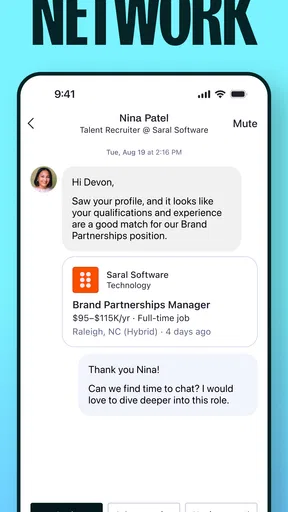
- Direct messaging helps you connect with employers and career advisors.
- Useful for discovering internships, entry-level roles, and campus opportunities.
- Profile tools let you showcase skills, experience, and extracurricular activities.
- Career resources and events can support long-term professional development.
Limitations of Handshake: Jobs & AI work
- Many listings are aimed at students or recent graduates, limiting broader searches.
- Some opportunities may be restricted to specific schools, locations, or eligibility groups.
- Job recommendations can feel repetitive if your profile is not regularly updated.
- Employer response times vary, so messages may not receive timely replies.
- Certain features and listings may require account verification or school affiliation.
Similar Picks in This Category
View All
LinkedIn: Community & Network
LinkedIn3.8

Zoom Workplace
zoom.com4.1

Microsoft Teams
Microsoft Corporation4.6

Meta Business Suite
Meta Platforms, Inc.4.6

Webex Meetings
Cisco Systems, Inc.4.5

TeamViewer Remote Control
TeamViewer4.4
Frequently Asked Questions
What is Handshake Jobs & New Careers, and who is it designed for?
Handshake Jobs & New Careers is a career platform focused mainly on students, recent graduates, and early-career professionals. It connects users with employers, internships, entry-level positions, career events, and university resources. The app is especially useful for people who want opportunities related to their education, discover companies hiring new talent, and receive guidance while beginning or changing their professional career.
Do I need a university or college account to use Handshake?
Access requirements can vary depending on your university, region, and the features available through your institution. Many students use Handshake with a school-provided account, while some job-search functions may be available to other users through a personal registration. If your university partners with Handshake, signing in with your academic credentials usually provides the most complete access to career services, events, employer connections, and campus-specific opportunities.
Can I apply for jobs and internships directly through the Handshake app?
Yes, Handshake allows users to search for jobs, internships, part-time roles, and graduate opportunities, then review application instructions from participating employers. Some positions support applications within the platform, while others redirect you to the company’s external careers website. Before applying, check the listing carefully for eligibility requirements, deadlines, required documents, and whether the employer accepts applications from your location or academic background.
How does Handshake recommend jobs and career opportunities?
Handshake uses information such as your profile, education, interests, skills, preferred locations, saved searches, and previous activity to display potentially relevant opportunities. The quality of recommendations improves when your profile is complete and up to date. Adding a resume, career interests, work preferences, and skills can help employers find you and make the job feed more useful, although recommendations may still vary by institution and market.
Is Handshake safe to use, and how can I avoid misleading job listings?
Handshake includes employer profiles, job details, reporting tools, and university career-support features, but users should still evaluate every opportunity carefully. Never send money, banking passwords, or sensitive identity documents to an unverified contact. Review the employer’s website, confirm the application address, be cautious of unrealistic pay promises, and report suspicious listings or messages through the platform or your university career center before proceeding.
